
1) After Java 8, what do you think about Java? Is it still an object oriented language or it has turned into functional programming language?
Java is still an object oriented language where everything is done keeping objects (data) in mind. But, with the introduction of new features in Java 8, you can use Java as a functional programming language also. You can treat it as as an added advantage over the other languages which are either object oriented or functions oriented. From Java 8, you can use Java either in an object-oriented programming paradigm or in a functional programming paradigm. It supports both.
2) What are the three main features of Java 8 which make Java as a functional programming language?
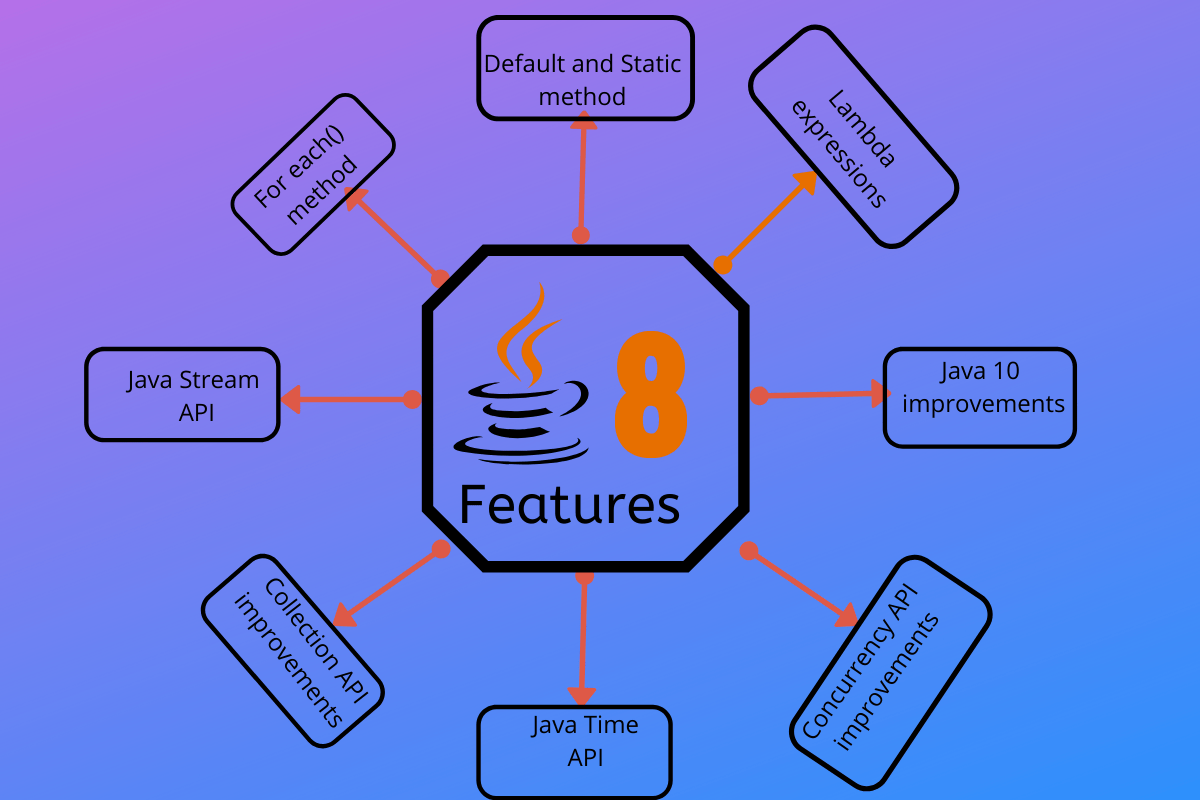
Lambda expressions, functional interfaces and Stream API are the three main features of Java 8 which enables developers to write functional style of programming in Java also.
3) What are lambda expressions? How this feature has changed the way you write code in Java? Explain with some before Java 8 and after Java 8 examples?
Lambda Expressions can be defined as methods without names i.e anonymous functions. Like methods, they also have parameters, a body, a return type and possible list of exceptions that can be thrown. But unlike methods, neither they have names nor they are associated with any particular class.
Lambda expressions are used where an instance of functional interface is expected. Before Java 8, anonymous inner classes are used for this purpose. After Java 8, you can use lambda expressions to implement functional interfaces.
These lambda expressions have changed the style of programming in Java significantly. They have made the Java code more clear, concise and readable than before. For example,
Below code shows how Comparator interface is implemented using anonymous inner class before Java 8.
Comparator<Student> idComparator = new Comparator<Student>() {
            @Override
            public int compare(Student s1, Student s2) {
                return s1.getID()-s2.getID();
            }
        };
and after Java 8, above code can be written in a single line using Java 8 lambda expressions as below.
Comparator<Student> idComparator = (Student s1, Student s2) -> s1.getID()-s2.getID();
Another example,
Implementation of Runnable interface using anonymous inner class before Java 8 :
Runnable r = new Runnable() {
            @Override
            public void run() {
                System.out.println("Runnable Implementation Using Anonymous Inner Class");
            }
        };
Implementation of Runnable interface using lambda expressions after Java 8 :
Runnable r = () -> System.out.println("Runnable Implementation Using Lambda Expressions");
4) How the signature of lambda expressions are determined?
The signature of lambda expressions are derived from the signature of abstract method of functional interface. For example,
run() method of Runnable interface accepts nothing and returns nothing. Then signature of lambda expression implementing Runnable interface will be () -> void.
compare() method of Comparator interface takes two arguments of type Object and returns int. Then signature of lambda expression for implementing Comparator interface will be (Object, Object) -> int.
5) How the compiler determines the return type of a lambda expression?
Compiler uses target type to check the return type of a lambda expression.
For example,
Runnable r = () -> System.out.println("Runnable Implementation Using Lambda Expressions");
In this example, target type of lambda expression is Runnable. Compiler uses run() method of Runnable interface to check the return type of lambda expression.
6) Can we use non-final local variables inside a lambda expression?
No. Only final local variables are allowed to use inside a lambda expressions just like anonymous inner classes.
7) What are the advantages of lambda expressions?
- Lambda expressions let you to write more clear, concise and readable code.
- Lambda expressions removes verbosity and repetition of code.
8) What are the functional interfaces? Do they exist before Java 8 or they are the whole new features introduced in Java 8?
Functional interfaces are the interfaces which has exactly one abstract method. Functional interfaces provide only one functionality to implement.
There were functional interfaces exist before Java 8. It is not like that they are the whole new concept introduced only in Java 8. Runnable, ActionListener, Callable and Comaprator are some old functional interfaces which exist even before Java 8.
The new set of functional interfaces are introduced in Java 8 for writing lambda expressions. Lambda expressions must implement any one of these new functional interfaces.
9) What are the new functional interfaces introduced in Java 8? In which package they have kept in?
Below is the list of new functional interfaces introduced in Java 8. They have kept in java.util.function package.

10) What is the difference between Predicate and BiPredicate?
- Predicate is a functional interface which represents a boolean operation which takes one argument.
- BiPredicate is also functional interface but it represents a boolean operation which takes two arguments.
11) What is the difference between Function and BiFunction?
- Function is a functional interface which represents an operation which takes one argument of type T and returns result of type R.
- BiFunction is also functional interface which represents an operation which takes two arguments of type T and U and returns a result of type R.
12) Which functional interface do you use if you want to perform some operations on an object and returns nothing?
Consumer
13) Which functional interface is the best suitable for an operation which creates new objects?
Supplier
14) Along with functional interfaces which support object types, Java 8 has introduced functional interfaces which support primitive types. For example, Consumer for object types and intConsumer, LongConsumer, DoubleConsumer for primitive types. What do you think, is it necessary to introduce separate interfaces for primitive types and object types?
Yes. If an input or output to an functional interface is a primitive type then using functional interfaces which support primitive types improves performance rather than using functional interfaces which support object types. Because it removes unnecessary boxing and unboxing of data.
15) How functional interfaces and lambda expressions are inter related?
Lambda expressions are introduced to implement functional interfaces in a simplest way and new functional interfaces are introduced to support lambda expressions in Java 8. Both together have given a new dimension to Java programming where you can write more complex data processing queries in a few lines of code.
16) What are the major changes made to interfaces from Java 8?
From Java 8, interfaces can also have concrete methods i.e methods with body along with abstract methods. This is the major change made to interfaces from Java 8 to help Java API developers to update and maintain the interfaces. The interfaces can have concrete methods either in the form of default methods or static methods.
17) What are default methods of an interface? Why they are introduced?
Default methods of an interface are the concrete methods for which implementing classes need not to give implementation. They inherit default implementation.
Default methods are introduced to add extra features to current interfaces without disrupting their existing implementations. For example, stream() is a default method which is added to Collection interface in Java 8. If stream() would have been added as abstract method, then all classes implementing Collection interface must have implemented stream() method which may have irritated existing users. To overcome such issues, default methods are introduced to interfaces from Java 8.
18) As interfaces can also have concrete methods from Java 8, how do you solve diamond problem i.e conflict of classes inhering multiple methods with same signature?
To solve the diamond problem, Java 8 proposes 3 rules to follow. They are,
Rule 1 : Select classes over interfaces
If your class inherit multiple methods with same signature then a method from super class is selected (Remember a class can inherit only one class).

class has higher precedence than interface default methods.
In the diagram above, foo() method of class D will inherit from class C.
Rule 2 : Select most specific interfaces than general interfaces.
If your class doesn’t extend any class and inherit multiple methods with same signature from multiple interfaces which belong to same hierarchy, then a method from most specific interface is selected.
sub-interface has higher priority
In the above diagram, foo() of class C will inherit from default method of interface B.
Rule 3 : InterfaceName.super.methodName()
If your class doesn’t extend any class and inherit multiple methods with same signature from multiple interfaces which doesn’t belong to same hierarchy, then override that method and from within body explicitly call desired method as InterfaceName.super.methodName().
class C must override foo method
In above class diagram, since interface A & B are at same level, to resolve conflict, class C must provide its own implementation by overriding method foo().
19) Why static methods are introduced to interfaces from Java 8?
Java API developers have followed the pattern of supplying an utility class along with an interface to perform basic operations on such objects.
For example, Collection and Collections. Collection is an interface and Collections is an utility class containing only static methods which operate on Collection objects.
But from Java 8, they have break this pattern by introducing static methods to interfaces. With the introduction of static methods to interface, such utility classes will disappear gradually and methods to perform basic operations will be kept as static methods in interface itself.

 Harshit Jain